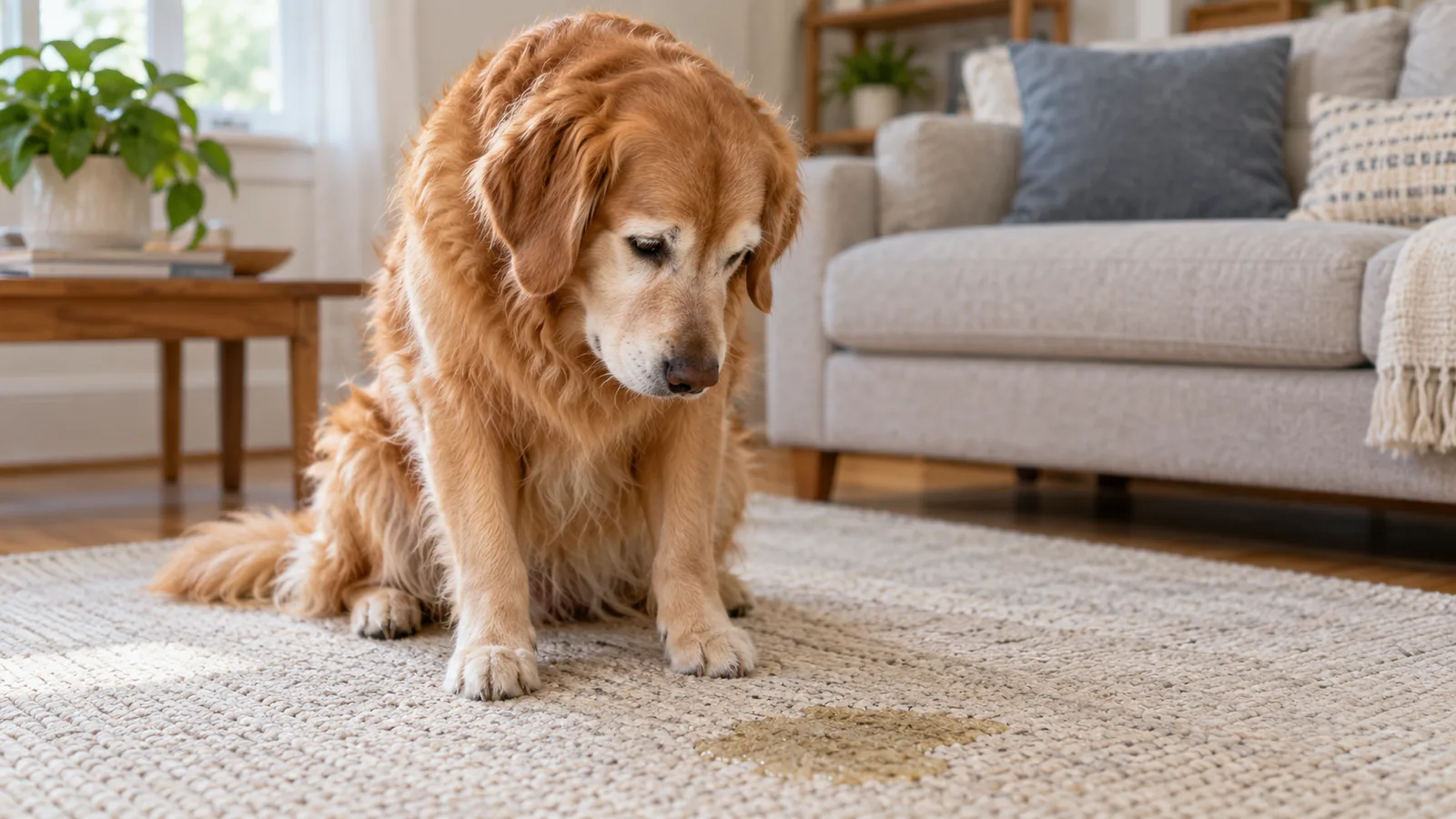
A wet spot on the couch cushion, a damp dog bed every morning, or a puppy who dribbles no matter how many trips outside you make: urinary incontinence shows up in dogs of every age, and it isn't a housetraining failure. It means urine escapes without your dog meaning to let it go. In a puppy, the cause may be anatomy they were born with. In a spayed female, it's often a weak bladder sphincter. In any dog it can be an infection, bladder stones, a hormone disease, a back problem, or in an intact male, the prostate. Most of these respond well once the right one is found.
Cleaning up after a leaking dog wears on a family, and the good news is that a urine sample and an exam usually start pointing toward an answer on the first visit. Noah's Ark Veterinary Hospital in Williamsburg is AAHA-accredited, and we have the testing and imaging to separate an infection from a weak bladder or a problem further upstream. For many dogs, the lab work that comes with a routine wellness exam is what turns up an early kidney or hormone change behind the leaking. We'll talk through every option with you, including the most cost-effective path to a dry bed. If your dog has started leaking, let us find out why.
Urinary Incontinence in Dogs: The Basics
- Incontinence means urine escapes while your dog is relaxed or asleep, so it isn't a housetraining failure and it isn't something they can be trained out of.
- The cause depends a lot on age and sex: birth defects in puppies, a weak sphincter in spayed females, prostate problems in intact males, and infections, stones, hormone diseases, or back problems at any age.
- A urine sample is where most answers start, with bloodwork and imaging filling in the rest when that first round doesn't explain things.
- Many dogs respond well to treatment, and washable bedding plus clean, dry skin keeps everyone comfortable while the cause gets sorted out.
What Counts as Urinary Incontinence in Dogs?
Urinary incontinence means urine escapes without your dog choosing to let it go, which is why a housetrained dog can leave a damp spot on their bed and have no idea it happened.
Holding urine is a three-part job: the bladder stores it, the sphincter keeps the outlet closed, and the nerves coordinate the two. Urination problems can begin anywhere along that chain, and when one link fails the others can't make up for it. Not every wet spot is true leaking.
| What you're seeing | Where it usually points |
| A damp patch where your dog was asleep, with no sign they noticed | True incontinence, most often a weak bladder sphincter |
| The water bowl emptying faster, large puddles, asking out overnight | A disease driving up urine volume, such as diabetes or a hormone disorder |
| Squatting again and again with little coming out, straining, pink urine | An irritated bladder: infection, stones, or inflammation |
| A dog who asks to go out but can't quite make it, and stays dry asleep | A holding or mobility problem rather than involuntary leaking |
Age itself doesn't make a bladder leak. Senior dogs leak more often because they've had more time to develop the conditions behind it, and those conditions are usually treatable.
Is It Leaking or a Behavior Issue?
A few common problems look like incontinence but aren't, and they're handled very differently:
- Submissive or excitement urination: Puppies and young dogs who squat and dribble when greeting someone or being scolded aren't leaking. Most outgrow it with calm greetings and confidence building.
- Marking: Small amounts on vertical surfaces like furniture legs and door frames, often in intact dogs or homes with a new pet, is a territorial behavior.
- Cognitive decline: Some senior dogs forget their housetraining as their brain ages, urinating while fully awake, often alongside nighttime pacing or confusion.
- Incomplete housetraining: Puppies have small bladders and need trips outside every few hours, so accidents in a young dog may simply be a schedule problem.
What Causes a Dog to Leak Urine?
Leaking is a symptom rather than a diagnosis. The usual causes are a weak bladder sphincter after a spay, an infection or bladder stones, a disease that drives up urine volume, a nerve or disc problem, anatomy a puppy was born with, and in older dogs a bladder or prostate tumor.
A Weak Bladder Sphincter, Usually After a Spay
The most common reason a spayed female dog leaks is a weak urethral sphincter, the muscle that keeps the bladder outlet closed, and it shows up more often in larger breeds. Muscle tone there slips furthest when she's fully relaxed, which is why the first clue is usually a wet patch where she was sleeping. It often shows up months to years after surgery, and extra weight makes it more likely. Neutered males can develop it too, though much less often.
Anatomy a Puppy Was Born With
A puppy who has dribbled since the day they came home may have an ectopic ureter, a ureter that empties past the bladder instead of into it, so the urine never gets held in the first place. Leaking in a young dog deserves a look rather than a wait, since these built-in problems are often correctable with surgery. Some female dogs are also born with a recessed vulva, tucked into a fold of skin, which traps urine and leads to repeated infections and skin irritation. Weight loss helps, and in some dogs a minor surgery to remove the skin fold solves it. Many soft tissue surgeries are done at our hospital, and for a repair this specialized we'll look at the imaging with you first and say honestly who is the right person to do it.
Infection, Stones, and an Irritated Bladder
Urinary tract infections bring urgency, straining, frequent small puddles, and sometimes blood in the urine, and they sit at the top of the list to rule out because they're common and simple to treat. Bladder stones and cystitis, which is inflammation of the bladder lining, can produce much the same picture. A stone that slips into the urethra can block the flow of urine completely, so a dog straining with nothing coming out needs to be seen that day rather than watched overnight.
Diseases That Make a Dog Drink and Urinate More
Diabetes pushes sugar into the urine and pulls water along with it, so a diabetic dog drinks and produces far more urine than they can reasonably hold between trips outside. Cushing's disease, an overproduction of the stress hormone cortisol, and early kidney disease also drive up urine volume. So do steroid medications like prednisone, which is worth mentioning if your dog recently started one. In an unspayed female, a sudden jump in thirst a few weeks after a heat cycle can signal pyometra, a life-threatening uterine infection that needs same-day care.
Nerve and Spinal Problems
Intervertebral disc disease, a slipped or ruptured disc in the spine, can interrupt the nerve signals that let a dog feel a full bladder and empty it on purpose, and bladder control is often one of the first things to slip when the spine is involved. Dribbling that turns up alongside weakness, wobbliness, or pain in the back end needs looking at today rather than next week, so call us and we'll get your dog in for emergency care during our open hours, Saturday mornings included.
Nerve damage and blockages can also cause overflow incontinence, which works the opposite way from a weak sphincter. The bladder can't empty properly, fills past capacity, and urine dribbles out around the edges. A dog who dribbles constantly but strains or produces little when they try to go may have an overfull bladder rather than a leaky one, and that needs to be seen promptly.
Prostate Problems in Male Dogs
Most unneutered male dogs develop an enlarged prostate as they age. Along with prostate infections and cysts, it can cause dribbling, straining, blood in the urine, or bloody drips from the penis. Neutering usually shrinks a benign enlarged prostate within a few weeks.
Bladder and Prostate Tumors in Older Dogs
Bladder and prostate cancer can disrupt normal urination in an older dog, showing up as straining, leaking, or blood in the urine. Most senior leaking turns out to be something far more ordinary, but any change in an older dog's urinary habits is worth checking.
How Do We Find Out Why Your Dog Is Leaking?
Diagnosis starts simple and builds only if it needs to. A workup almost always opens with a urine test, because one sample screens for infection, shows how well the kidneys are concentrating urine, and can flag sugar or crystals that point the investigation somewhere else.
Much of diagnosing incontinence is the history you bring in: whether the leaking happens asleep or awake, in puddles or dribbles, and whether the water bowl is emptying faster than it used to. If you can catch a sample in a clean container that morning, bring it along. It also helps to measure how much your dog drinks in a day: fill the bowl from a measuring cup, track every refill for 24 hours, and subtract what's left. A healthy dog drinks roughly an ounce of water per pound of body weight a day, so noticeably more than that is worth mentioning.
- Urine culture: confirms an infection and tells us which antibiotic will clear it.
- Bloodwork: looks for diabetes, kidney changes, and the hormone disorders that drive up urine volume.
- Imaging: finds stones, a mass, or a ureter that was never routed into the bladder. We have digital X-ray and ultrasound here in Williamsburg, which covers most of what an incontinence workup needs.
What Treatments Work for Urinary Incontinence?
Treatment follows the cause, which is why the diagnosis comes first. Incontinence medications work by restoring tone to the sphincter or replacing the hormonal signal behind it, and because the right drug and dose vary between dogs, both need a prescription and a recheck.
| Cause | What treatment usually looks like |
| Weak bladder sphincter | A daily prescription medication, often phenylpropanolamine, plus a recheck to settle on the lowest dose that keeps your dog dry |
| Urinary tract infection | Antibiotics chosen from the culture, then a follow-up sample to confirm the infection has cleared |
| Bladder stones | A prescription diet dissolves some types. Others have to come out surgically, and we may recommend removing even the dissolvable kind when stones are large or numerous, to head off a blockage |
| Anatomy your dog was born with | A surgical repair to route the ureter into the bladder where it belongs |
| Diabetes, Cushing's, or kidney disease | Treating the disease itself, with the leaking easing as urine volume comes back down |
| Nerve or disc disease | Medication and strict rest for the spine, with help emptying the bladder while the nerves recover |
Some dogs need a different drug, a combination, or a dose change before they stay dry. For spayed females, an estrogen medication called estriol is another option, and some dogs do best on it alone or alongside phenylpropanolamine. Because phenylpropanolamine can raise blood pressure, rechecks and blood pressure checks at our Williamsburg hospital are part of staying on it, and they're where we adjust the plan as your dog's needs change. Refills are easy to order through our online pharmacy.
When medication alone doesn't keep a dog dry, specialists can offer procedures such as collagen injections that bulk up the urethra or an adjustable cuff placed around it. We'll tell you honestly whether one of these makes sense for your dog and help with the referral.
How Do You Keep a Leaking Dog Comfortable at Home?
At home, coping with incontinence mostly comes down to more frequent trips outside and keeping the skin dry, since urine left sitting against the skin can scald it.
- Bedding: layer a waterproof pad under a washable blanket so you're swapping one piece instead of stripping a whole bed.
- Diapers and belly bands: washable dog diapers for females and belly bands for males help indoors, as long as you change them often so urine doesn't sit against the skin.
- Bathroom breaks: take your dog out first thing in the morning, before bed, and after naps, since an emptier bladder has less to leak.
- Skin care: when you find your dog damp, wipe the belly and inner thighs with warm water, pat dry, and keep the hair in that area trimmed short.
- When home care isn't enough: redness, raw patches, or a sour smell means the skin needs help. Our veterinarians and technicians can judge whether a sore needs treatment and show you how to clip and clean the area safely.
Don't scold your dog for a wet bed, because they had no say in it. And don't cut back their water: restricting what they drink won't reduce the leaking, it hides the drinking changes that help us find the cause, and it risks dehydration.
When Should You Call Us About New or Changing Leaking?
New or changing urinary signs deserve a fresh look, even in a dog whose incontinence already has a name and a plan. The same dog can pick up a second cause years later, and a medication that kept a dog dry at six isn't guaranteed to hold at eleven.
Watch for leaking that starts while your dog is awake and moving when it used to happen only in their sleep, a volume that climbs, straining or blood in the urine, noticeably more drinking, or a back end that looks weak. If you see any of that, give us a call and we'll start with a new urine sample rather than assuming the old diagnosis still explains everything.
Questions Families Ask About Urinary Incontinence
Did spaying cause my dog's incontinence?
Spaying is linked to an increased risk of a weak bladder outlet, because the hormones that help maintain tone in that muscle drop after surgery. That's a risk rather than a certainty, many spayed dogs never leak a drop, and it doesn't make spaying the wrong call given the cancers and infections it prevents.
Can my dog be trained not to leak?
Training won't resolve involuntary leaking, because your dog isn't choosing to do it, and correcting them only teaches them to be anxious around you. House training does help the other kind of accident, where a dog signals and can't quite wait, but urine that escapes during sleep needs a medical answer.
Does leaking mean my dog is in pain?
The leaking itself doesn't hurt, but several of the conditions behind it can. A bladder infection stings, stones ache, a disc problem in the spine is often very painful, and skin that stays wet becomes sore. A dog who's dribbling and also restless, hunched, licking at themselves constantly, or reluctant to jump up on the couch needs an exam.
Start With a Urine Sample and an Exam
Urinary incontinence is common, and most cases are treatable once we know what's driving it. Schedule a visit at Noah's Ark Veterinary Hospital in Williamsburg and we'll start with a urine sample and an exam, then tell you what we found and what we'd do about it.