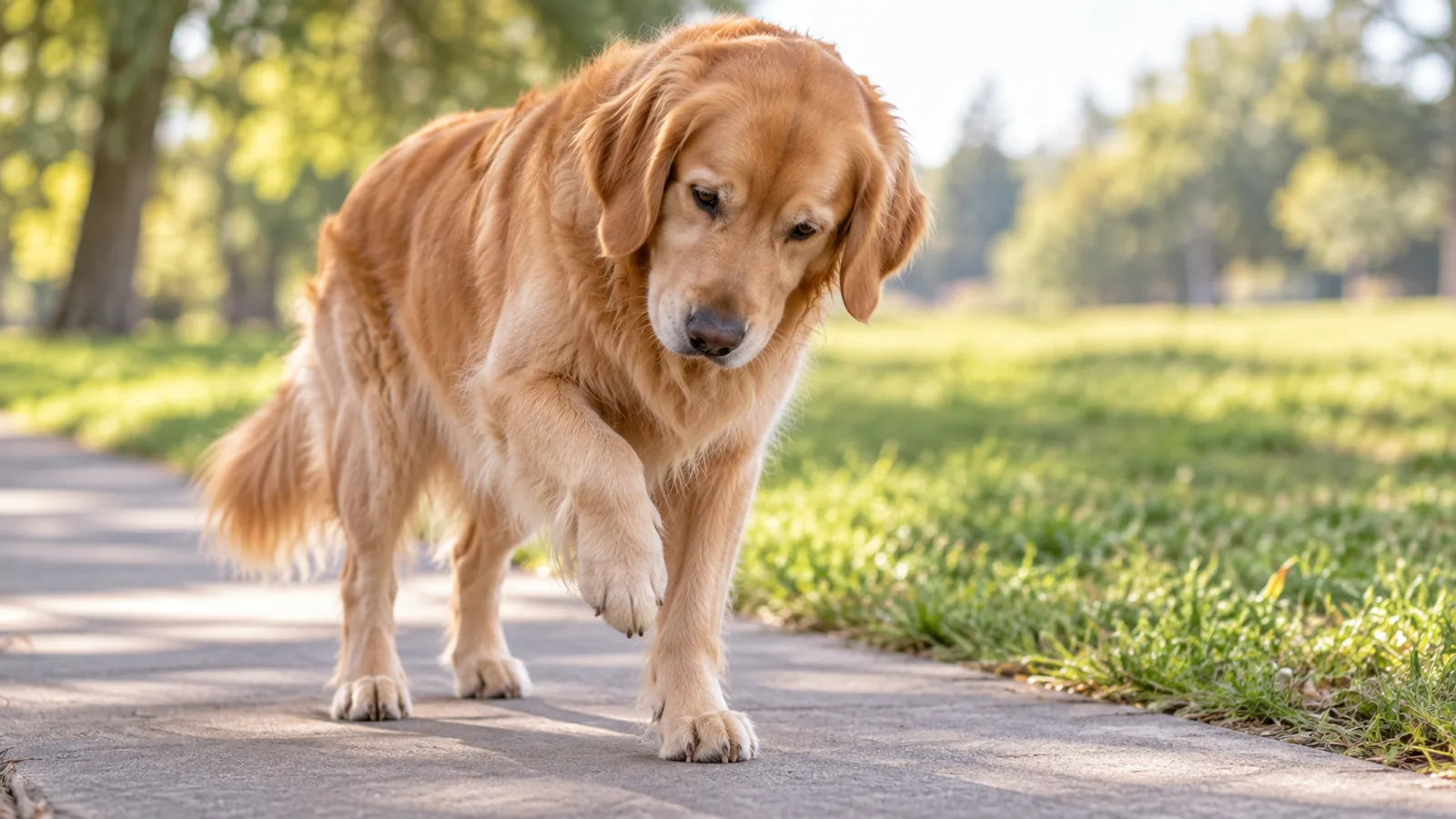
A limp that has not gone away usually means something in the leg is still injured, inflamed, or unstable, and rest alone will not settle it. Limping in dogs and cats comes from two directions: sudden trouble like a cracked nail, a bite wound, or a fracture, and wear-and-tear problems like arthritis, hip dysplasia, or a failing cruciate ligament. If your pet will not put any weight on the leg, holds it at an odd angle, or started limping after a fall or a car accident, that is a right-now problem, and swelling or crying out when you touch the leg should be looked at the same day. Those slower causes are not emergencies, but they still deserve an appointment within a day or two, since unmanaged pain changes how your pet moves and puts the other three legs under strain.
Noah's Ark Veterinary Hospital in Williamsburg sees limping dogs and cats every week, and the question is almost always the same: is this a sprain that will settle, or something structural in the joint or bone? A hands-on exam and digital X-rays we read on site usually tell us which, and our AAHA-accredited hospital can get your pet on pain control while we sort out the cause. If your pet will not put the foot down, or the limp followed a fall, call us and we will make room for an urgent visit; if that happens after hours, head to the nearest 24/7 emergency hospital. For a limp that has hung on longer than it should, reach out to us.
What a Limp Is Telling You
- A limp that hasn't cleared within a day or two deserves an exam, and one that follows a fall, a car strike, or a hard fetch session deserves one the same day.
- Sudden limps usually start in the foot or the soft tissue, gradual ones usually start inside a joint, and the two need different workups.
- Dogs hide discomfort well. A mild limp often means more pain than it looks like from across the room.
- Leave your own medicine cabinet closed. Ibuprofen and acetaminophen can poison a dog at a dose that would seem tiny to you.
What Causes a Dog to Start Limping?
Most limps trace back to one of two patterns: something that happened in a single moment, like a torn nail or a bad landing off the couch, or something inside a joint that has been wearing down for months. Both deserve an exam. What changes is how fast you need one.
| Pattern | What you notice at home | Usual suspects | How soon to be seen |
| Sudden | Fine one minute, three-legged the next, often with a yelp or a lot of licking at one foot | Torn nail, cut pad, grass awn, bite wound, strain, fracture | Same day if no weight goes on the leg, otherwise within a day |
| Gradual | Stiff after naps, slower on stairs, quitting the last stretch of a walk, on and off for weeks | Arthritis, hip or elbow dysplasia, kneecap luxation, cruciate tear, bone tumor | Within a week, sooner if it keeps getting worse |
Why Did My Dog Suddenly Start Limping?
Most sudden limps start at the ground. A dog who was chasing a squirrel two minutes ago and is now holding up a front paw has usually done something to a foot. That's where our hands go first.
- Feet and toes: Cracked or torn nails bleed and throb, because the quick underneath carries both nerves and blood. Foxtails burrow between the toes and travel inward, leaving a swollen, licked-raw spot that keeps getting worse. Cut pads, glass, and a bee sting in the webbing belong in the same group.
- Bites and punctures: A puncture that seals over traps bacteria under the skin, and the abscess that follows shows up as a hot, painful limp days after a scuffle at the dog park.
- Muscles and ligaments: A hard cut across wet grass or a bad landing off the deck strains muscle and overstretches ligaments.
- Bones and joints: Fractures, dislocated joints, and torn ligaments can all happen in one step, especially after a fall, a jump out of a truck bed, or a run-in with a car.
- Nerves and spinal cord: Compression of the spinal cord or damage to a nerve can cause a leg or paw to drag, which can look like a limp, and is an emergency.
Before you call, spread the toes and look at every web space, check the nails and the pads, and run a hand down the leg for heat or swelling. A grass awn buried in the skin or a puncture that's already puffing up needs numbing and proper cleaning rather than tweezers at the kitchen table, and our team handles foreign body removal and wound repair here.
What If the Limp Came On Slowly?
The slow ones are sneaky. There's no yelp and no moment to point to, just a dog who takes the stairs one at a time, needs a minute to loosen up after a nap, or bows out of the last ten minutes of the walk. Families often tell us their dog is just getting older. Much of the time, what they're describing is pain.
- Wear and tear: Arthritis is the most common reason a middle-aged or senior dog limps, and it builds so gradually that the routine change is easier to spot than the limp itself.
- Hips: Hip dysplasia shows up as a bunny-hopping run and trouble rising, sometimes well before a large-breed dog's first birthday. Leggs-Perthe disease causes death to the head of the femur due to lack of blood flow, more common in young small breed dogs.
- Knees: A skip-and-carry limp that disappears after a few strides is classic for patellar luxation, most often in small breeds. A partial cruciate tear tends to come and go in a back leg, worse after a big day.
- Shoulders and elbows: Elbow dysplasia shows with a front-legged limp. Osteochondritis dissecans (OCD) can show an off-and-on or constant limp. It is most common in rapidly growing young dogs in the shoulders and elbows, though rear legs can also be affected, from a detached piece of cartilage.
- Growing puppies: A limp that migrates from one leg to another in a young large-breed dog may be panosteitis, a painful but self-limiting bone inflammation they grow out of.
- Older large-breed dogs: A limp that keeps getting worse, especially alongside firm swelling above the wrist or below the shoulder, is worth ruling osteosarcoma out early, since bone pain from a tumor does not ease with rest.
- Look-alikes: Tick-borne infections like Lyme disease cause a shifting lameness with fever and sore joints, and they're common enough around here to test for. Immune-mediated diseases like IMPA (immune-mediated polyarthritis) cause a stiff gait and swollen joints.
We check for early stiffness at routine wellness exams, and because a stoic pet holds still through an exam, your description of the past six months usually tells us more than one walk down the hallway does. We may also recommend X-rays to screen for diseases like hip dysplasia if you have a young, large breed puppy, because there are early surgical interventions that can prevent a lifetime of pain.
When Is a Limp an Emergency?
Crying out, collapse, heavy bleeding, an open wound, or a limb that looks visibly wrong all mean your dog should be seen right now rather than tomorrow. A leg that dangles, angles the wrong direction, or will not take any weight after a fall or a car strike points to broken bones, and that's a same-day problem. An unstable fracture keeps damaging muscle and blood supply with every hop, and an open wound over a joint gives bacteria a direct route inside. Here's what helps in the meantime:
- Muzzle kindly, first: Even the gentlest dog may snap when a painful leg gets touched, and a soft muzzle protects everyone. A cone or towel draped over the head works, too.
- Cone: If your dog insists on licking a wound, use a cone to prevent access.
- Leash-only: If your dog can walk, keep them leashed to prevent any further damage.
- Support, don't splint: A homemade splint usually shifts the broken ends around. Slide a folded towel under the belly as a sling for a big dog, or carry a small one with the sore leg facing up.
- Control bleeding: Firm, steady pressure with a clean cloth beats any ointment, and a torn nail bleeds far more dramatically than the injury warrants.
- Hold the food: If sedation or anesthesia ends up in the plan, an empty stomach makes it safer.
- Give us a heads-up: Call us on the way, and we'll have pain relief ready when you pull in.
We provide emergency care while we are open, Monday through Friday and Saturday mornings. If your dog is hurt after we've closed, drive straight to the nearest 24/7 veterinary emergency hospital instead of waiting for us to open.
How Do Veterinarians Find the Cause of a Limp?
Finding the cause starts with your story: which leg, how long, worse after rest or after exercise, constant or intermittent, any fall or scuffle. If you can take a video of the limp at home, that helps. Many dogs limp less, or not at all, when they reach the practice. Then we watch the gait, at a walk and a trot, both directions. A head bob that drops when the good front leg lands means the other front leg hurts; a hip that hikes upward means the trouble is in back.
Next come the hands. We feel every joint from toe to hip, flex and extend each one, and watch for the small flinch that tells us we've found the spot. Feeling for abnormal drawer motion in the knee is how a cruciate ligament injury gets confirmed, and a tense, sore dog often needs light sedation first, because bracing against a painful exam can mask laxity completely, and good X-ray positioning for hips and elbows is nearly impossible in a patient holding themselves rigid.
When a limp moves from leg to leg or arrives with a fever, digital radiographs and in-house bloodwork together help sort a tick-borne infection or an immune-mediated joint problem from a mechanical one, and a small sample of joint fluid adds the final piece when infection is on the table. Advanced imaging such as CT or MRI occasionally answers a question X-rays can't, and we refer those studies to a specialty hospital and coordinate the appointment for you.
What Are the Treatment Options for a Limping Dog?
The right plan depends on what's driving the limp, how severe it is, and what your dog's daily life looks like.
| Type of problem | Typical first steps | What recovery tends to look like |
| Mild strain or sprain | Anti-inflammatory medication made for dogs, strict rest, a recheck if nothing changes | Improvement in a few days, normal activity over two to three weeks |
| Arthritis or dysplasia | Weight control, daily pain management, joint support, traction at home | Managed long term with good days and harder days |
| Cruciate tear, fracture, severe luxation | Pain control now, referral to a board-certified veterinary surgeon | Several weeks of restricted activity, then rebuilding muscle |
| Bone tumor | Imaging, staging, strong pain control, referral for treatment options | Varies with type and stage, with comfort as the first priority |
What Can I Do at Home for a Mild Limp?
Rest is the actual treatment for a mild strain, and a dog turned loose in the yard on day three usually re-injures the same spot. Real rest means leashed bathroom trips only, no stairs, no couch launches, no fetch, and a gated room or crate for the dog who can't self-regulate.
Your own painkillers are off the table. In a dog, ibuprofen and acetaminophen cause stomach ulcers, kidney failure, and liver damage, and there is no dose small enough to be both useful and safe. Prescription anti-inflammatories made for dogs are a different story, and we check bloodwork before starting them. If the limp hasn't improved after a couple of quiet days, or it returns the moment activity picks up, schedule a recheck rather than starting the rest clock over.
How Do We Manage Long-Term Joint Pain?
Arthritis is managed rather than cured, and real comfort comes from stacking several small things at once: weight control, anti-inflammatory medication, joint supplements, traction on slick floors, and exercise that stays steady instead of weekend-heavy.
Medication usually anchors the plan, whether that's a daily anti-inflammatory, gabapentin for nerve-related discomfort, or a monthly injectable option for osteoarthritis pain. Omega-3 fatty acids and prescription joint diets help from the food bowl, and nutrition counseling and weight management is the lever with the biggest return, since every extra pound lands on joints that are already struggling. Rehabilitation therapy, including underwater treadmill work and targeted strengthening, helps many dogs rebuild the muscle that pain took away.
At home, runners over hardwood, a ramp at the back steps, a harness with a handle for the car, and a bed that supports rather than swallows all buy comfort without a prescription.
When Does a Limping Dog Need Surgery?
Surgery enters the conversation when something structural won't heal on its own: a torn cruciate, a fracture that needs plating, a kneecap that dislocates constantly, Leggs-Perthe disease, or a hip that no longer sits in its socket. We don't perform orthopedic procedures here. We refer those to a board-certified veterinary surgeon and keep your dog comfortable in the meantime. Wound repair, abscess drainage, amputations, and other soft tissue surgery we take care of in our own operating room.
Recovery asks more of the family than the procedure does: weeks of confinement and leash-only walks, then a slow return to normal, and skipping that part is the main reason repairs fail. Families brace for the worst when a limb can't be saved, but most dogs are up and walking within days of amputation surgery and back to their usual routine inside a few weeks.
How Does Pain Change a Dog's Behavior?
Pain rarely looks like whining. It looks like a dog who stops meeting you at the door, grumbles when a child leans on them, sleeps in a new spot on the floor, or leaves half of dinner in the bowl. Those changes often arrive before the limp does, and they're worth telling us about.
The jump into the back of the car turns into a pause and a look. The toy basket goes untouched. Irritability with other pets is one of the most misread signs of all, and it usually improves once the pain does.
Before the appointment, jot down what your dog has stopped doing and how sleep and appetite have shifted. Those notes shape what our veterinarians prescribe and how we measure whether it's working.
Questions We Hear About Limping Dogs
My dog stopped limping after a couple of days. Do we still need an appointment?
It's worth keeping. A limp that resolves with rest and returns with activity is the signature pattern of a partial cruciate tear and of early arthritis, and both get harder to treat the longer the joint stays unstable. An exam during a quiet stretch can still find joint laxity, thickening around the knee, or pain on deep flexion that you'd never notice at home. If the same leg has gone lame twice in a month, that's a pattern, not bad luck.
Can something other than the leg cause a limp?
Plenty of problems outside the leg cause a limp. Disc disease in the neck or lower back makes a dog favor a leg that's structurally fine, often with scuffed toenails or a paw that drags slightly. Tick-borne infections cause sore, shifting lameness with fever. An infected nail bed, a pad burn from hot pavement, or referred pain from the shoulder can all look identical to a joint problem from across the room.
Getting Your Dog Comfortable Again
Limping is one of the most common reasons dogs come to see us here in Williamsburg, and it's also one of the easiest things to talk yourself out of. A dog who's still wagging and still eating doesn't look like a dog in trouble, and the leg gets watched for another week. Waiting rarely makes a joint problem simpler to fix. If your dog has been favoring a leg, book a visit at Noah's Ark Veterinary Hospital and we'll find out what's going on and get them moving comfortably again.