A home rehabilitation plan is more than a list of exercises. It sets out what your pet is cleared to do each day, how the house should be arranged so there is no slipping or jumping, how much activity is allowed between sessions, when pain medication is given, and what progress should look like from week to week. The right amount is set by the condition being treated, not by how good your dog or cat looks on a given morning. Rehabilitation helps well beyond surgery cases, and most of the recovery happens at home between visits.
Noah's Ark Veterinary Hospital, an AAHA-accredited practice in Williamsburg, helps you carry out the plan your pet's surgeon or rehabilitation therapist set, and checks that it is actually working. Our comprehensive veterinary visits tell us how the joint or limb is holding up and whether a recovery is heading the right way. Wellness exams are a good time to have us watch your pet move, flag anything that looks like a setback so the plan can be adjusted, and talk through weight, which matters more for sore joints than almost anything else you control at home. If progress has stalled, or you are not sure how much activity is safe right now, request an appointment and we will go over the routine together.
Start Here: The Home Rehab Basics
- Sudden refusal to use a leg, a hot or oozing incision, or new crying out means stop and call us, not rest and watch.
- Consistency beats intensity, and skipping a week and then doubling up to make it up is one of the fastest ways to lose progress.
- Dogs rebuild through controlled leash walks and weight-shifting drills; cats do better with short, play-shaped sessions and a house rearranged so nothing requires a jump.
- A simple written log and regular rechecks let us adjust the routine while it's still working, rather than after everything has stalled.
Which Pets Benefit from Rehabilitation, and What Does It Do for Them?
Post-surgical patients rebuilding coordination, arthritic seniors holding onto mobility, neurologic cases recovering from spinal injury, and overweight pets easing pressure on sore joints all do well with rehabilitation therapy. What ties them together is lost function, not a shared diagnosis.
Veterinary physical rehabilitation pairs targeted exercise with hands-on therapy and pain control, rebuilding strength and confidence in a pet whose body has stopped moving the way it used to. A dog who has been sore for six weeks learns to avoid the painful leg, and that habit outlasts the injury unless something deliberately retrains it.
| Type of patient | What we're rebuilding | What the home work usually looks like |
| After orthopedic surgery | Weight-bearing on the repaired leg, thigh and hip muscle | Strict activity limits, short leash walks, sit-to-stand reps |
| Arthritis and senior stiffness | Range of motion, endurance, weight control | Daily gentle movement, traction underfoot, ramps instead of stairs |
| Spinal or nerve injury | Coordination, foot placement, core stability | Slow step-over work, sling support, skin and bladder monitoring |
| Extra body weight | Endurance and reduced joint load | Measured meals, walk time built up gradually |
| Soft tissue injuries | Healing without stiffening | Rest paired with prescribed motion, staged return to activity |
Watching your pet walk, turn, and rise from a down tells us more than any single measurement, and our digital X-ray and ultrasound fill in what the eye can't see, like whether a repaired joint is settling well or soft tissue damage is driving a limp. We also compare muscle mass side to side, since a thigh an inch smaller than its partner tells you how much work that leg has been avoiding.
Why Does So Much of Rehab Happen at Home?
Clinic visits set direction and check the work, but the other twenty-three hours of the day belong to you. The daily repetitions, the activity restrictions, the medication schedule, and the flooring underfoot all live at your house, and that's where a recovery either holds together or quietly comes apart.
Nobody gets this perfect: someone leaves a door open, a grandchild throws a ball. If you're two weeks in and can't tell whether the limp is improving or sliding backward, check in with us instead of guessing for another month.
What Happens If You Skip Sessions or Push Too Hard?
Rehabilitation exercises are planned with purpose, which is why skipping a week and then doubling up to catch up sets a recovery back further than the missed days alone ever would. Too little movement lets muscle waste and scar tissue tighten. Too much re-inflames the very tissue you're trying to heal.
A dog four weeks out from a cruciate repair gets one unplanned sprint after a squirrel and spends the next ten days worse than they were. Steady, unremarkable work is what wins. When a pet’s pain is controlled properly, they often feel better than what their surgical repair or condition is actually ready for, and it’s up to you to keep them safe and on the right track for the stage of their recovery.
Three habits set a recovery back, and all three are common. Never give human pain medication such as ibuprofen, naproxen, or acetaminophen; these can cause kidney failure, stomach ulcers, and in cats, death, even in small amounts. Don't add exercises from a video because your pet seems ready, since the plan's difficulty was chosen for the tissue that's healing, not for enthusiasm. And don't force a stiff joint through a stretch your pet resists, because range-of-motion work only helps when the motion stays gentle and pain free.
Some changes mean stop and call rather than rest and watch:
- Sudden refusal to use a leg, especially one that was bearing weight yesterday.
- Heat, swelling, discharge, or gaping at an incision, or a pet who's suddenly determined to lick it.
- Crying out on a movement they handled fine before, or trembling and panting at rest.
- Loss of bladder or bowel control in a pet recovering from a spinal injury, which we want to know about the same day.
Our team handles emergency care during our open hours, so a setback can be looked at quickly rather than waiting out a weekend.
Which In-Clinic Therapies Work Alongside the Home Plan?
Formal rehabilitation programs add what a living room can't reproduce. Those services live at a certified rehabilitation practice rather than at our hospital, so we refer for them and stay with you on the medical side of the plan.
- Water work: Buoyancy carries a large share of a pet's body weight, so water therapy lets a healing limb move through its full range and build muscle without the load a hard floor demands. An underwater treadmill turns hydrotherapy into gait practice, because the water slows each step enough that a dog has to place the weak leg properly instead of hopping over it.
- Laser therapy: Light energy delivered over a sore joint or a healing wound can lower inflammation and take the edge off discomfort, which is often what makes the exercise portion possible at all.
- Manual therapy: Pet massage increases circulation to healing tissue and releases the secondary muscles that tighten up when a pet has spent weeks favoring one leg. Guided stretching keeps a joint from locking down while it's being used less than usual.
- Strength and balance training: Supervised work on unstable footing rebuilds the deep core and limb muscle that holds a joint tracking correctly under load.
Our doctors stay in the middle of it, giving advice and tracking the recovery.
What Does At-Home Rehab Look Like Day to Day?
Home rehab is short, repetitive, and honestly a little boring: a few minutes of prescribed exercises two or three times a day, leash walks measured in minutes instead of blocks, and a house arranged so nothing invites a jump. Dogs and cats arrive at the same place by different routes.
How Do You Build a Dog's Strength Without Overdoing It?
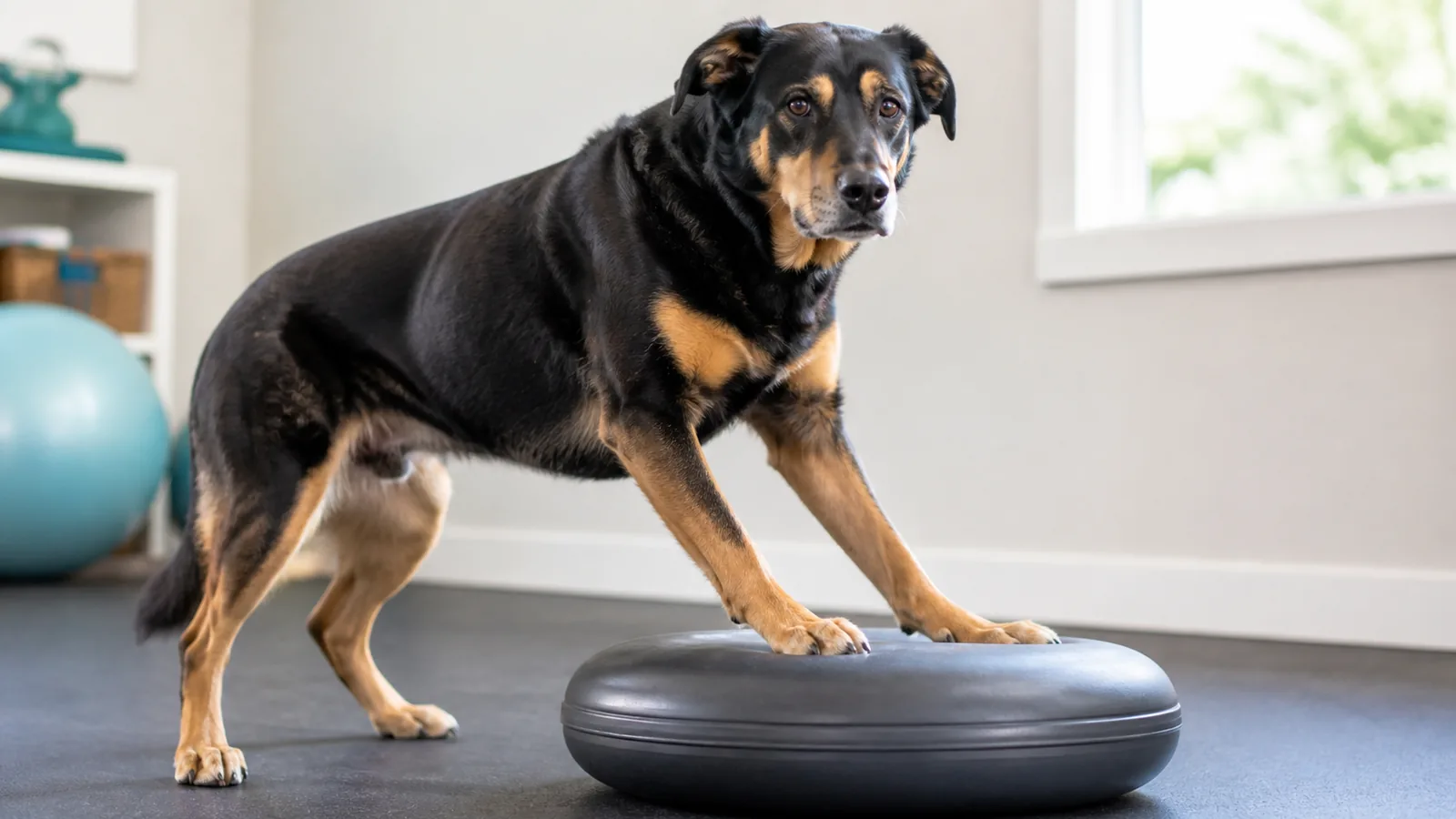
Progress for dogs comes from controlled, repeatable work: timed leash walks, weight-shifting drills on a stable surface, and slow sit-to-stands that force the weak leg to participate. Change one variable at a time, and only after your dog handles the current level without extra soreness the next morning. Simple rehabilitation fitness equipment like a balance disc or an inflatable peanut helps, though a folded yoga mat or a couch cushion does the same job on day one.
| Exercise | What it builds | How to keep it safe |
| Controlled leash walking | Endurance, even stride, weight-bearing | Short leash, non-slip footing, add a minute or two at a time |
| Sit-to-stand reps | Hip, thigh, and core strength | Square sits on a flat surface, stop before the form falls apart |
| Slow figure-eights and wide turns | Balance and lateral control | Wide arcs first, never on tile or hardwood |
| Step-overs on low poles | Foot placement and coordination | Poles no higher than the hock, one pass at a time |
| Weight shifting on a balance disc | Deep stabilizing muscle | Hand on the harness, a few minutes only |
| Gentle hill or ramp work | Rear-end power | Uphill first, slow descents, skip it if the leg is trembling |
The house matters as much as the drills. Runners over hardwood, a baby gate at the stairs, a raised food bowl, and trimmed nails with the hair clipped from between the pads all remove chances to fall. Mobility harnesses with front and rear handles let you take weight off a wobbly back end on stairs or slick floors without hauling a dog up by the belly.
How Do You Rehab a Cat Who Won't Do Exercises?
Feline rehabilitation runs on short, play-shaped sessions, since a cat will reach, stretch, and step over an obstacle for a wand toy long before she tolerates anything that looks like a repetition count. The work is identical. The packaging is completely different.
Wand toys raised just above head height encourage reaching and a stretched spine, and a pool noodle cut in half on the floor becomes a step-over lane. Puzzle feeders and other enrichment toys turn a meal into a few minutes of stepping, reaching, and pawing, which is exactly the low-impact movement a recovering cat needs.
Then take the jumping out of her day. A litter box with a low entry, steps or a ramp to the window perch she's always used, food, water, and a bed on one level, and soft bedding well away from stairs and slick floors will do more for a sore cat than any single exercise. Cats hide both progress and pain remarkably well, so wellness visits do real work here: we can watch her move and adjust the comfort plan before a plateau turns into a slide.
Which Tools and Mobility Aids Are Worth Buying?
Three kinds of gear earn their place, and most families need far less than the internet suggests.
- Balance and strengthening gear: Stability balls and balance platforms make the core work to keep the body level, which builds the deep muscle that holds a healing joint steady between sessions. Wobble boards belong in the same category and are easy to overuse.
- Support and traction: Slings, rear-support straps, toe grips, and rubber-backed runners cost little and prevent the falls that undo weeks of careful work. A rolled bath towel under the belly works in a pinch for a dog who needs help on three steps.
- Long-term wheels: Carts and wheelchairs are the long-game mobility aids, keeping a pet with lasting hind-end weakness upright, exercising, and getting outside on their own terms.
Fit matters more than brand, and measurements matter more than reviews, so ask us before you buy. A harness that sits an inch too far forward can rub an incision or shift load onto the leg you're trying to protect.
How Do You Keep the Routine Going and Know It's Working?
Progress in rehabilitation moves slowly enough that you'll miss it without a record. A short daily note on what you did, how long the walk lasted, and how your pet moved the next morning turns a vague sense of "about the same" into a trend we can read at a glance.
Keep it to a few lines a day:
- Which exercises you completed, and how many reps
- Walk time in minutes, plus the surface
- Any slips, falls, stairs taken, or jumps you didn't catch in time
- Medication given, and whether it seemed to help
- Appetite, weight if you have a scale, and sleep quality
- One short video a week of your pet walking away from the camera
That video is the single most useful thing families bring us. Memory smooths things over; a clip from three weeks ago doesn't. Bring the log to every recheck and we'll compare it against what we see on the exam table.
The small wins are worth noticing. A cat who reaches the second step of the ramp, a dog who sits square instead of flopping onto one hip, a senior who trots the last few yards home: those are the milestones that predict the big ones.
What Goals Are Realistic, and What Does Rehab Deliver Long Term?
Realistic goals are functional ones: walking a comfortable distance without soreness afterward, managing the porch steps, getting into the litter box cleanly, holding a healthy weight, and using all four legs instead of three. A full return to pre-injury athletics happens for some pets and not others, and which group yours is in usually becomes clear over the first couple of months.
Goals shift as pets change, which is why our AAHA-accredited hospital reassesses rather than handing over a plan and waving you off. For a young dog after a repair, we're aiming at full function. For a fourteen-year-old with hip arthritis, the target is independence: sleeping through the night, rising without help, staying interested in the world.
If you're unsure whether a plateau is normal or a sign that something else is going on, ask our veterinary team. Sometimes a stall means the exercises need to advance, and sometimes it means pain control isn't adequate or a second joint has started complaining, and we'd rather find that in week six than week sixteen.
What Williamsburg Families Ask Us About Home Rehab
How long will my pet need rehabilitation?
It depends on what you're recovering from. A straightforward soft tissue injury might need a few weeks of controlled work. Recovery after a cruciate repair or a spinal injury is measured in months, with the steepest gains early and slower refinement afterward. Arthritis rehab isn't a course with an end date at all; it turns into a maintenance routine that keeps a senior comfortable for years. We'd rather reassess every few weeks than promise a finish line we can't see yet.
Can I use heat or ice at home?
Sometimes, but only when your veterinarian or therapist has told you which one and when. Cold packs suit the first days after surgery or a fresh injury, when swelling is the problem. Warmth suits stiff, chronic joints before gentle movement. Getting it backwards can worsen swelling or burn thin skin, and a pet who can't get up also can't move away from something too hot. Always use a towel barrier, keep sessions brief, and never apply either to a red or open incision.
My dog seems back to normal. Can we stop the exercises early?
Feeling good returns well before strength does. A dog who's stopped limping can still have noticeable muscle loss on the repaired side, and that gap is exactly where re-injury happens, usually during one enthusiastic sprint across the yard. Finish the program even when it looks unnecessary, and let a recheck tell you when the muscle has caught up with the attitude. Stopping at the halfway mark is the most common reason a good surgical result turns into a disappointing one.
Starting Rehab Early Gives Your Pet the Best Shot
Stiffness after a nap, a shorter stride on the morning walk, a cat who's quietly stopped using the top of her tree: these are the easiest problems to work on and the ones most often written off as ordinary aging. Watching a pet lose ground is hard, and doing the daily work when progress is invisible is harder, so you shouldn't have to judge it alone. Noah's Ark Veterinary Hospital in Williamsburg would rather look at a small change early than a large one late. Schedule a mobility assessment, and together we can build a plan to fit your house, your schedule, and what your pet can honestly manage this week.