Certain dog breeds carry traits that put them at much higher risk for painful dental disease, tooth loss, and infection that can spread to the rest of the body. Small and toy breeds like Yorkies, Chihuahuas, Poodles, Dachshunds, and Maltese crowd 42 adult teeth into a jaw built for far fewer, which traps plaque, accelerates gum disease, and often leads to early tooth loss. Flat-faced breeds like Bulldogs, Pugs, and Boxers deal with rotated and misaligned teeth that wear unevenly and hide bacteria. Some breeds develop jaw disorders, some are prone to cysts in the jaw, and some even tend to have extra teeth.
At Noah's Ark Veterinary Hospital, we build the dental plan around what your dog's breed actually needs, not a one-size schedule. Our dental care for dogs in Williamsburg includes a full oral exam, dental X-rays under anesthesia to see what is happening below the gumline, ultrasonic and hand scaling, polishing, and extractions when a tooth is beyond saving, all with monitored anesthesia and post-op pain management. We take the time to walk you through what we find in your dog's specific mouth and talk through home care that fits your routine and your budget. If your dog has bad breath, is chewing on one side, or has not had a dental in a while, request an appointment and we will take a careful look.
Quick Facts
- Small and toy breeds carry the same full set of 42 adult teeth as a big dog, packed into a jaw a fraction of the size, so gum disease often shows up years earlier.
- Big dogs are not off the hook: powerful chewers fracture teeth on hard objects, and several sporting and working breeds have inherited jaw and eruption problems of their own.
- Retained baby teeth, crowding, and misaligned bites are common in small breeds and set the stage for early periodontal disease if left alone.
- Bad breath, chewing on one side, or blood on a toy are early signals worth an exam, not a wait-and-see.
- Dental X-rays reveal disease below the gumline that a visual exam alone can miss, which is why they are part of every anesthetic cleaning.
Why Are Some Dog Breeds So Prone to Dental Disease?
Genetics and skull shape do most of the work. Small breeds carry a full set of 42 adult teeth in a jaw a fraction the length of a big dog's, and flat-faced breeds have compressed skulls that crowd and rotate their teeth. Both anatomies trap plaque and speed up gum disease. Large, powerful breeds face a different risk: enough bite force to crack a healthy tooth.
A Chihuahua and a Great Dane both grow the same number of teeth, but the Chihuahua has to fit them into a jaw a fraction as long, so each tooth takes up far more of the available room. That packing is what drives small-breed dental risk, and it explains why a five-pound dog can develop painful gum disease years before a Labrador shows any tartar. Crowding is the root of most toy breed dental problems: tightly packed teeth hold plaque against the gumline, where it hardens into tartar and erodes the bone anchoring each tooth.
In flat-faced breeds, the rotated teeth wear unevenly and hide bacteria in spots a toothbrush struggles to reach, which is exactly why these dogs benefit from earlier and more frequent professional teeth cleaning than a larger breed with a roomier mouth.
Size is only part of the picture, though. Inherited traits shape nearly every part of the mouth, including how many teeth a dog grows, the angle they erupt at, how the upper and lower jaws line up, how the gum tissue behaves, and how the jaw joint is built. That is why breed matters at every size, and why knowing what your dog is predisposed to lets us look for it before it becomes painful.
What Genetic and Structural Dental Problems Show Up in Different Breeds?
Breed-related dental problems fall into four main groups: eruption and bite issues, gum and soft-tissue disease, fractures and jaw joint trouble, and cysts or defects present from birth.
Retained Baby Teeth and Bite Alignment
Small and toy breeds are famous for hanging onto their baby teeth. A baby tooth that refuses to fall out as the adult tooth comes in usually calls for deciduous canine tooth removal, since two teeth sharing one socket trap food, irritate the gums, and force the adult tooth into a crooked position. Catching these during puppy wellness visits is the easiest way to head off crowding before the adult bite locks in, and we often remove them during spay or neuter surgery.
Alignment is the other half of the story. When teeth come in at the wrong angle, malocclusion and tooth malposition can leave a lower tooth stabbing into the roof of the mouth, causing sores and chronic pain that a puppy has no way to tell you about. Some of these teeth simply need to come out, which is where dental extractions restore a comfortable bite and stop the soft-tissue trauma.
Several alignment problems show up often enough in specific breeds to be worth naming:
- Overbites: Collies, Shetland Sheepdogs, Shepherds, and Dachshunds top the list for dogs whose lower jaw is shorter than the upper, causing trauma from teeth aligning incorrectly or difficulty eating.
- Underbites: Extremely common and often considered “normal” in flat-faced pets, the lower jaw sticks out further than the upper. Similar to overbites, trauma from misaligned teeth and difficulty eating can occur.
- Base narrow canines: In Bull Terriers, German Shepherds, and Shar-Peis, the lower canine teeth erupt too upright and point inward instead of sitting outside the upper teeth. Every time the mouth closes, those canines press or puncture into the palate. Caught early in a young dog, ball therapy can tip the teeth outward into a normal position using nothing more than a correctly sized rubber ball the puppy holds and chews. Older dogs or deeper punctures usually need crown shortening or extraction instead.
- Lance teeth: Shetland Sheepdogs and other collie-type breeds are the classic example. The upper canine erupts pointing forward, like a tusk, instead of down. It crowds the incisor next to it, traps food in the gap it creates, and can rub against the lip. Left alone, the crowded area becomes an early pocket of gum disease.
All are easiest to address while a dog is young, which is one more reason we look closely at the bite at every puppy visit rather than waiting for a problem to announce itself.
Gum and Soft-Tissue Changes
Gums tell you a lot about what is happening underneath. In Boxers, Bulldogs, and some Collies, overgrown gum tissue known as gingival enlargement creates deep pockets around the teeth that pack with food and bacteria, quietly loosening teeth long before you notice anything is wrong. The tissue looks thick and puffy, sometimes almost swallowing the crown of the tooth, and the pocket underneath is where the real damage happens. In some dogs, trimming back the excess tissue is part of the plan so the pockets stop reforming.
Cavalier King Charles Spaniels and Maltese are prone to a different and considerably more painful problem. Chronic ulcerative paradental stomatitis, often shortened to CUPS, happens when the immune system overreacts to the plaque on the teeth and attacks the lip and cheek tissue that touches them. The result is raw ulcers, sometimes called kissing ulcers, wherever soft tissue meets a tooth surface. Dogs with CUPS often have breath that is genuinely hard to be near, drool heavily, and may paw at the mouth or go quiet and withdrawn. It is not a hygiene failure on your part, and it does not respond to a cleaning alone. Management depends on getting plaque down to nearly zero, which for many dogs means meticulous daily home care and, in advanced cases, extracting the teeth the tissue is reacting against.
Fractured Teeth and Jaw Joint Problems
Any dog can break a tooth, but the ones with the jaw strength and the drive to chew hard objects break them most. Labradors, German Shepherds, Pit Bull type dogs, Malinois, and other powerful chewers regularly crack the large upper fourth premolar on antlers, hooves, hard nylon bones, ice cubes, and rocks. A fractured tooth that exposes the pulp, the living tissue inside, is painful and gives bacteria a direct route to the root and the bone around it. Dogs almost never stop eating over it, which is exactly why these fractures get missed. Depending on the tooth and the damage, the options are root canal therapy to save the tooth or extraction to remove the source of pain.
Jaw joint problems are less common but worth knowing about in sporting breeds. Spaniels, setters, and retrievers are overrepresented for temporomandibular joint disorders, where the hinge connecting the jaw to the skull is shallow or loose. Some of these dogs will yawn and then find their mouth stuck open, which is alarming to watch and genuinely painful. Others show pain when chewing, chew on one side, or resist having their head handled. Imaging is what sorts a joint problem from a tooth problem, since the outward signs overlap.
Cysts and Congenital Oral Deformities
A tooth that never erupts is not a harmless quirk. In Shih Tzus, Lhasa Apsos, and Boxers, an unerupted tooth, most often a first premolar, can trigger a dentigerous cyst, a fluid-filled sac that forms around the buried crown and slowly dissolves the surrounding jawbone. It is silent, it is invisible from the outside, and by the time it causes a visible swelling it has usually destroyed a meaningful amount of bone. This is the reason a missing tooth deserves an X-ray rather than a shrug: if the tooth is not gone but buried, removing it early prevents the cyst entirely.
Why Do Small Teeth Cause Such Big Problems in Toy Breeds?
Two things work against a toy breed's mouth: thinner enamel and a thinner jawbone. Tartar builds up quickly along teeth this tightly spaced, and once gum disease sets in, it reaches the jawbone far faster than it would in a larger dog. With so little bone to spare, there is less margin before that infection reaches the root and the tooth is at risk.
The speed of that damage is why imaging matters so much for these dogs. A visual exam only shows the crown, so we use dental radiographs to see the roots and the bone below the gumline, where the real trouble often hides. Catching bone loss early gives us a chance to save teeth that would otherwise be lost.
| Problem | Breeds most affected | What it can lead to |
| Retained baby teeth | Toy and small breeds | Crowding, trapped food, early gum disease |
| Crowded teeth | Flat-faced and toy breeds | Early gum disease and bone loss |
| Malocclusion | Flat-faced and toy breeds | Soft-tissue sores, uneven wear, pain |
| Base narrow canines | Bull Terriers, German Shepherds, Shar-Peis | Palate punctures, chronic pain |
| Lance teeth | Shelties and collie-type breeds | Crowding, food trapping, lip trauma |
| Gingival enlargement | Boxers, Bulldogs, some Collies | Deep pockets, loose teeth, infection |
| CUPS | Cavaliers, Maltese | Painful ulcers, severe breath odor, tooth loss |
| Fractured teeth | Strong-jawed chewers of any breed | Exposed pulp, root abscess |
| TMJ disorders | Spaniels, setters, retrievers | Jaw locking, pain when chewing |
| Dentigerous cysts | Shih Tzus, Lhasa Apsos, Boxers | Bone loss around a buried tooth |
What Are the Signs of Dental Problems, and When Should You Come In?
Watch for changes in breath, chewing, and behavior, since dogs are experts at hiding mouth pain and rarely stop eating even when their teeth hurt. Swollen or bleeding gums, especially when you see blood on a chew toy or a pink tinge in the water bowl, are one of the clearest early signals that the mouth needs a professional look.
Here are the signs worth an evaluation:
- Bad breath: A sudden or worsening odor usually means bacteria are building up below the gumline.
- Chewing on one side: Dropping food or favoring one side of the mouth points to pain somewhere specific.
- Red or bleeding gums: Inflammation and bleeding are early gum disease, not just a bad day.
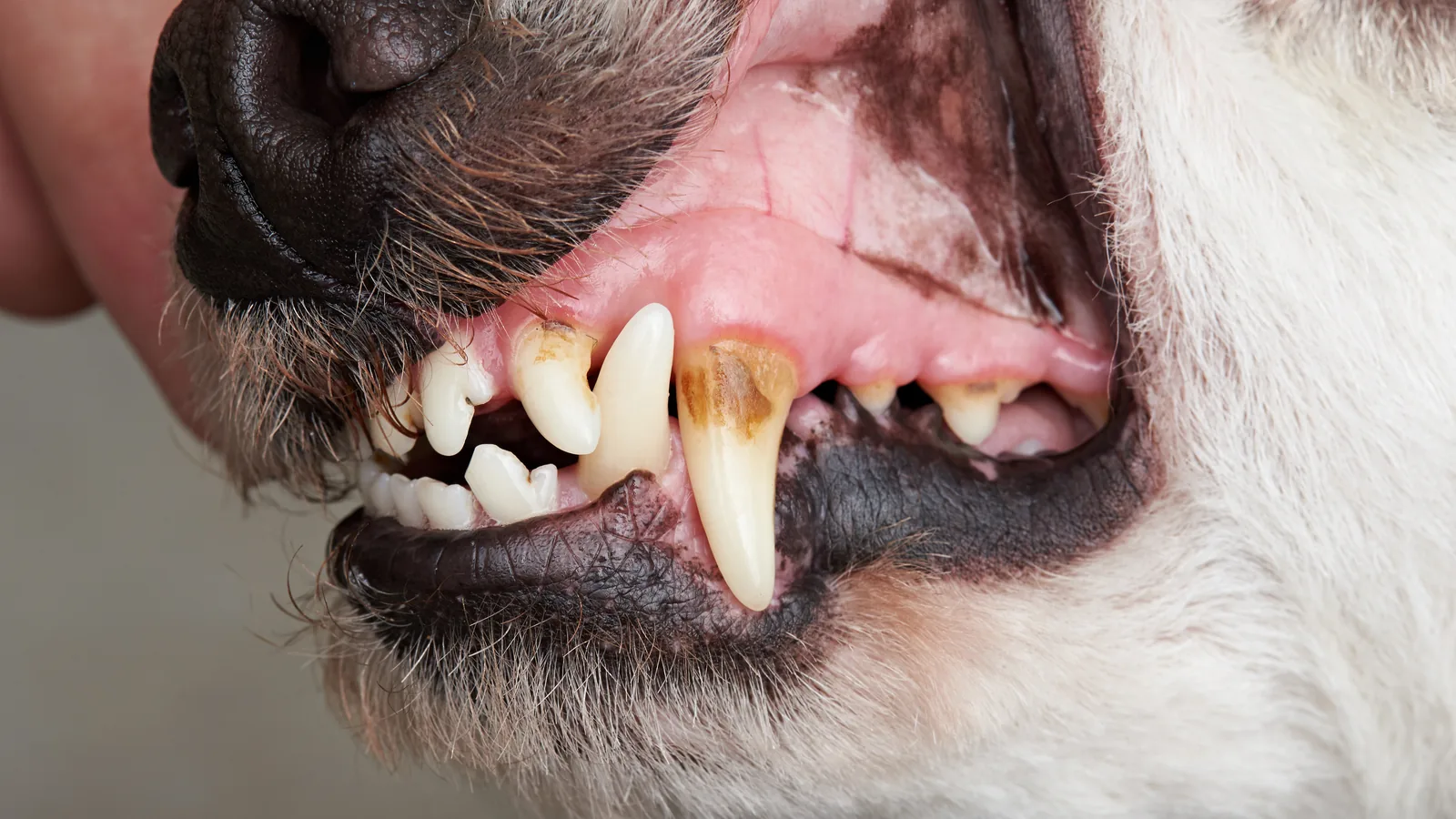
- Loose, broken, or missing teeth: Any of these warrants a same-week look. A tooth with a flat worn surface or a dark spot in the middle may be fractured, and a tooth that never came in at all deserves an X-ray.
- Raw or ulcerated spots on the lip or cheek: Especially in Cavaliers and Maltese, these point toward an immune-driven reaction to plaque rather than simple gingivitis.
- Pawing at the face or reluctance to be touched near the mouth: Subtle, but often the first thing families notice.
- Drooling or facial swelling: A swollen cheek or jaw can signal an abscessed tooth root or a cyst.
- Trouble opening or closing the mouth: A jaw that locks open or seems painful to move needs a same-day look.
If any of these show up, it is worth booking a comprehensive oral exam rather than waiting for the next annual visit. Small problems in a little mouth turn into big ones quickly, and a big dog's fractured tooth will not fix itself either.
How Do You Prevent Dental Disease in a High-Risk Breed?
Prevention blends daily home care with regular professional cleanings, and for high-risk breeds it starts earlier and runs more often than the average dog's schedule. The goal is to slow tartar down at home and clear what builds up before it damages bone. Home care that actually helps includes:
- Daily brushing: The single most effective habit, using a pet-safe toothpaste and working up to it gradually. For breeds prone to CUPS, near-perfect plaque control is not a nice-to-have; it is the treatment.
- Dental wipes: A good backup on days brushing does not happen, wiping plaque off the outer tooth surfaces.
- Appropriate chews: Size- and texture-matched VOHC-approved chews that flex rather than shatter. A simple rule: if you cannot dent it with a thumbnail, it is hard enough to break a tooth. Antlers, hooves, hard nylon, and real bones cause most of the fractures we see.
- Prescription dental diets: Kibble designed to scrub the tooth surface as your dog chews.
Part of prevention in small breeds is timing the check for retained baby teeth around the age the adult set finishes coming in, so any stubborn holdouts come out before they lock the bite into a crowded pattern. In breeds prone to malocclusions, that same window is when therapy has the best chance of working, so an early look is worth a lot. On the professional side, annual dental cleanings with oral X-rays keep disease from getting a head start. Because cleanings happen under anesthesia, we run pre-anesthetic bloodwork first to confirm your dog is a safe candidate. Prevention is nearly always more comfortable for your dog and easier on your budget than treating advanced disease.
Frequently Asked Questions About Breed-Related Dental Problems in Dogs
Are crooked teeth just a cosmetic issue?
It is a common misconception that crooked or misaligned teeth are only a cosmetic quirk, when in reality they wear unevenly, trap plaque in odd corners, and can rub sores into the cheeks and gums. A misaligned bite can cause real discomfort and speed up gum disease, so it is worth having checked even if your dog seems to be eating fine.
My small dog still eats normally. Could there still be a problem?
A normal appetite is one of the biggest traps with dental disease. Dogs are wired to keep eating through significant mouth pain, so a healthy appetite does not rule out advanced dental disease. Bad breath, subtle chewing changes, or tartar you can see are better clues, and much of the damage happens below the gumline where you cannot see it at all.
My dog is a big breed with clean-looking teeth. Do they still need dental care?
Yes. Larger breeds tend to develop periodontal disease later than toy breeds, but they fracture teeth far more often, and a broken tooth with an exposed nerve is painful whether or not there is tartar on it. Jaw joint problems and cysts around unerupted teeth also show up in medium and large breeds. Clean-looking teeth are a good sign, not a complete answer.
Does my dog really need anesthesia for a cleaning?
For a thorough job, yes. Anesthesia lets us clean below the gumline, take X-rays, and probe each tooth without causing pain or stress, which awake cleanings cannot safely do. We screen your dog beforehand with an exam and bloodwork, and monitor closely throughout, so the risk stays low while the benefit stays high.
Keeping Your Dog's Smile Healthy for Life
A healthy mouth is not a small thing. In high-risk breeds especially, staying ahead of dental disease protects your dog from chronic pain and eases the strain oral infection puts on the heart, kidneys, and liver. That care adds up to more comfortable years together.
The best plan is a shared one built around your dog's breed and your daily routine. If it has been a while since your dog's last dental, or you have noticed any of the signs above, reach out to schedule an oral exam and we will get started.